
By Etherly Barasa
Did You Know? Sugarcane Growers Have a Direct Democratic Pathway to the Kenya Sugar Board
With the 5 September 2026 Sugarcane Growers’ Election fast approaching, it is important for every registered grower to understand what the election is about, why it matters and, most importantly, how to participate.
Unlike many parastatal boards where members are largely appointed, the Kenya Sugar Board (KSB) has a distinctive representation structure. Sugarcane growers have the opportunity to elect their own representatives to the Board, giving them a direct voice in the governance and development of the sugar industry.
Under the Sugar Act, 2024, growers elect five representatives, with one representative coming from each of Kenya’s five sugar catchment areas. These representatives serve as an important link between growers and the institution responsible for regulating and developing the sugar industry.
WHY DOES THE ELECTION MATTER TO A GROWER?
The grower representative is much more than a name on a Board.
Since the Board cannot reach every farmer individually to listen to their grievances and concerns, it provides growers with a direct voice through the ballot. Through the election, farmers have the opportunity to choose a representative who will sit at the decision-making table and serve as their voice in advocating for their interests.
The elected representative is expected to champion issues affecting growers within their catchment area, including advocating for improved infrastructure, fair and timely payment for sugarcane, and better services and support for farmers. The representative also has the responsibility of communicating farmers’ challenges, concerns, and feedback to the Board, ensuring that the realities faced by growers at the grassroots level are brought to the attention of decision-makers.
The representative should be able to advocate for farmers’ interests without fear of intimidation or undue influence from either millers or government. More importantly, they are expected to champion policies and decisions that promote the welfare, sustainability, and economic interests of growers within their respective catchment areas.
In this way, the growers’ election is not simply about choosing a representative; it is a mechanism through which farmers participate in decision-making and ensure that their voices, experiences, and interests are represented at the highest level of the sugar industry.
SO, HOW DOES THE ELECTION ACTUALLY WORK?
The election process begins long before Election Day.
First, a voters’ register is prepared for each catchment area. The register is based on grower information and evidence of sugarcane growing or supply.
The Kenya Sugar Board (KSB) went round to all millers and farmers associations who assisted with the registration of growers and obtained their existing registers. These registers were then consolidated, followed by a verification exercise. This enabled the Board to establish a more comprehensive growers’ register, although the initial register was not able to accurately capture growers within specific zones.
The registration and verification exercise that was conducted provided an opportunity for growers who showed up to have their details verified, accurately captured, and mapped to their preferred polling centres based on their respective catchment areas.
Polling centres are then designated, taking into consideration factors such as the geographical location of growers, the number of farmers, distance and geographical features. A team was then deployed to determine suitable polling centres based on the above factors. After the first round, public participation was conducted, additional polling centres were identified and added. .the Board settled on 668 polling centres across the five catchment areas.
Once the polling centres had been determined, the recruitment and interview of enumerators through the mkulima onboard followed. The successful enumerators were then mapped to specific polling centres and trained before being deployed for the registration and verification exercise.
To create awareness among growers and encourage participation, the Board also undertook sensitization activities through local radio stations, roadshows, flyers, and other public awareness channels.
KSB’s procedure provides for the verification and updating of the register before the election. The registration exercise was subsequently rolled out. In 2026, the Board conducted the registration exercise from 25th May to 4th June 2026, during which thousands of growers turned up to participate in the exercise.
Following the successful completion of the registration and verification exercise, the Board embarks on preparations for the elections as it gives room for campaigns by aspiring representatives to take place.
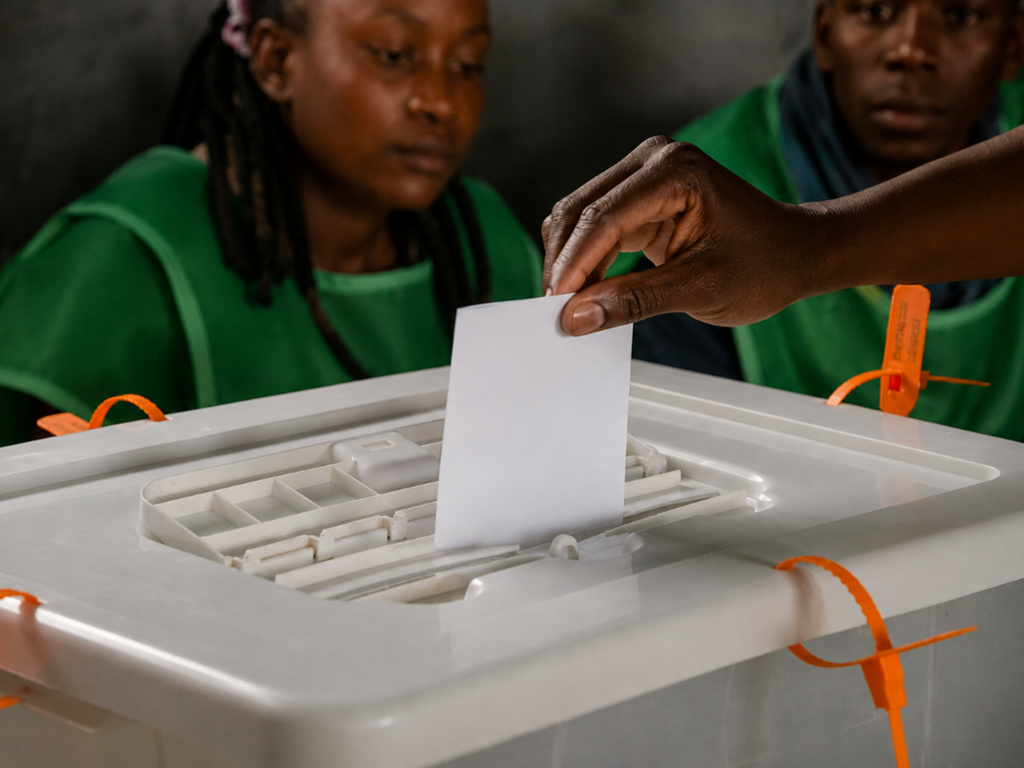
On the announced election date, registered and verified growers visit their designated polling centres with their identification documents and other required supporting documents to cast their vote in a secret ballot. Voting takes place from 7:00 a.m. to 5:00 p.m. on the Election Day
After voting closes, counting of the votes is conducted at the respective polling centres across all the catchment areas. The candidate who obtains the highest number of votes is declared the winner and becomes the elected representative of the growers.
WHO IS ELIGIBLE TO VOTE?
Living in a sugar-growing area does not automatically make someone a voter.
The election procedure requires a voter to be a registered sugarcane grower whose name appears in the voters’ register for the relevant catchment area.
The voter must also be able to provide the required identification and evidence of their sugarcane-growing or supply status during verification.
For the 2026 registration exercise, KSB required a National ID or passport, together with proof of sugarcane payment, supply statements or a current permit covering at least one month within the preceding 24 months, with special provisions applying only to the Coastal Catchment.
This is why registration matters.
If your details are not properly captured in the voters’ register, you may not be able to participate in the election.
So, if you registered or verified your details at a polling centre during the registration exercise, you should make plans to be at your designated polling centre on 5 September 2026 and exercise your right to vote.
WHO CAN VIE FOR THE POSITION OF GROWER REPRESENTATIVE?
The requirements for candidates are more demanding than those for an ordinary voter.
Under the KSB Grower Representative Election Procedure, a candidate must, among other requirements:
- Be an active sugarcane grower in the relevant catchment area.
- Have been a grower during the prescribed preceding 24-month period, except in the Coastal Catchment where this requirement is exempted.
- Have a valid sugarcane supply contract or supply statement with a miller within the catchment area.
- Have delivered at least 50 tonnes of sugarcane from their own farm to a factory within the catchment during the preceding 24 months, with an exemption for the Coastal Catchment.
- Be a Kenyan citizen.
- Have at least a Form Four/O-Level qualification.
- Meet the leadership and integrity requirements under Chapter Six of the Constitution.
- Not be an employee of the Kenya Sugar Board or a miller.
- Not hold an elective or nominated political office.
- Not be an undischarged bankrupt.
- Be an adult of sound mind.
- Pay the prescribed non-refundable nomination fee of KShs. 10,000.
- Contest in only one electoral area.
Candidates must also submit the required supporting documents, including identification, grower delivery statements, academic certificates, a KRA Tax Compliance Certificate, Police Clearance Certificate, EACC self-declaration and a Credit Reference Bureau certificate.
WHAT HAPPENS ON ELECTION DAY?
On Saturday, 5 September 2026, polling is scheduled to take place from 7:00 a.m. to 5:00 p.m. at designated polling centres across the five catchment areas.
As a registered and verified voter, you should report to your designated polling centre with your National ID or passport and any valid supporting document for identification and verification.
Voting will be conducted through a secret ballot, guided by the principle of one grower, one vote.
Once polling closes, votes will be counted at the polling centres. The results will then be collated at the catchment level.
The candidate who emerges victorious in each catchment will become the grower representative for that region, subject to the applicable statutory confirmation and appointment process.
WHAT IF THERE IS A DISPUTE?
The election procedure provides for an Election Dispute Resolution Committee to handle disputes arising in regard to election process.
A dispute concerning the shortlisting in a catchment area of candidates must be lodged in writing to the chairperson of the committee within 24 hours from the date the shortlisted candidates are published
The complainant is required to state the grounds of the dispute and attach relevant supporting documents within 24 hours and pay the board a non-refundable fee of Ksh 5,000.
The person filing the dispute shall serve the particulars of the dispute on the other affected party or parties and the Dispute Resolution Committee within 24 hours of filing. Service may be done by hand delivery, email, WhatsApp, or through the prescribed postal channels.
Upon receiving the dispute, the Election Dispute Resolution Committee gives the concerned parties notice of the date and place for the hearing.
The Committee considers the complaint, the response from the affected party, and the evidence presented before making its determination.
The Committee shall consider and determine the matter and communicate its final decision in writing within four days of receiving the dispute.
Bottom of Form
Where applicable, parties dissatisfied with certain decisions may pursue the matter further through the courts.
Any election complaint on Election Day shall be presented to the Presiding Officer and, if not resolved, be escalated to the chairperson of the Elections committee
The Presiding Officer/Chairperson of the Elections Committee shall conduct a thorough investigation and take immediate and appropriate action.
HOW OFTEN IS THE ELECTION HELD?
A grower representative serves a three-year term on the Board.
The law also provides for the terms of different Board members to expire at different times. This means that the entire Board is not necessarily renewed at once.
YOUR VOTE, YOUR VOICE, YOUR INDUSTRY
The Growers’ Representative Election is more than an election for a position on a Board. It is an opportunity for sugarcane growers to participate directly in deciding who will represent their interests at the institution responsible for regulating and developing Kenya’s sugar industry.
So, if you are a registered and verified grower, know your polling centre, carry your identification document and make your vote count.
5 SEPTEMBER 2026 — YOUR VOTE. YOUR VOICE. YOUR INDUSTRY.